 PopHorror Let's Get Scared

The Exorcism of Emily Rose, directed by Scott Derrickson, isn’t your typical horror film. Marketed as a supernatural drama, it pulls from the real-life case of Anneliese Michel — a young German woman who underwent Catholic exorcisms in the 1970s and later died. Her story set off firestorms of legal, medical, and theological debate. Derrickson takes that material and transforms it into something between a horror story and a legal thriller.
Not Just Another Possession Movie
Audiences expecting wall-to-wall scares often call this “not really horror.” But that’s intentional. The Exorcism of Emily Rose mixes genres, structuring itself like a courtroom drama while weaving in flashbacks of supernatural terror. It’s horror refracted through testimony and cross-examination — more about truth and belief than jump scares.
The Story
Before she was known as Deb from Dexter, Jennifer Carpenter played Emily Rose, a college student whose life unravels under violent seizures, disturbing visions, and what her devout family believes are demonic attacks. In the film, Father Moore (Tom Wilkinson) performs an exorcism, but Emily dies.
The fallout moves to the courtroom. Father Moore is charged with negligent homicide, forcing the court to weigh competing narratives: was Emily a victim of epilepsy and psychosis, or was she under siege by something darker?
Defense attorney Erin Bruner (Laura Linney) becomes the audience’s anchor — skeptical yet unsettled as testimony challenges her worldview. In the courtroom, Bruner faces off against a religious lawyer named Ethan Thomas (Campbell Scott). Despite being religious, Mr. Thomas sets out to convince the jury that Emily was not actually demon-possessed, and that Father Moore is responsible for Emily’s death.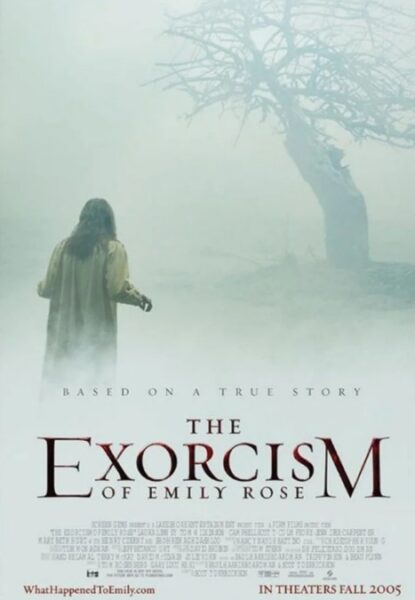
Style and Performance
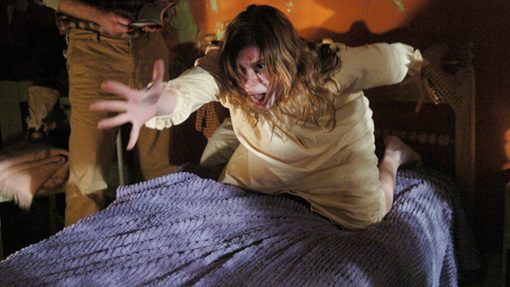
The exorcism sequences in The Exorcism of Emily Rose are deliberately raw, shot with an intensity that leans on Carpenter’s astonishingly physical performance: twisted body contortions, guttural voices, and visceral expressions of torment. In contrast, the courtroom sequences are restrained and procedural, grounding the supernatural elements in sober debate.
This dual style is what gives the film its tension — it refuses to let the audience escape into either genre fully.
Themes
At its core, the film wrestles with questions that resist easy answers. There’s “Faith vs. Science.” Can the unexplained be reduced to neurology and psychiatry, or is there space for spiritual explanations? Where treatment ends, does belief begin? In court, is “truth” defined by evidence, or by what a jury chooses to believe? Are demons external forces, or imagination-based manifestations of human suffering?
The film even brushes against biblical reflection. Examining the character’s beliefs feels like a key to how the movie stages its dialogue — measured, probing, and leaving room for conviction.
Reception
The reception for The Exorcism of Emily Rose was split. Some critics thought the film was slow or indecisive, unable to commit to either horror or drama. Others praised its ambition, especially Jennifer Carpenter’s unsettling performance and Derrickson’s attempt to elevate the exorcism subgenre into a conversation about belief.
Audiences, however, showed up. On a modest $19 million budget, Emily Rose grossed over $140 million worldwide. Though not the smash hit of the century, the studio successfully “eventized” it (to use an annoying expression), packaging the trial of faith and fear into a cultural flashpoint.
Closing Thought
The Exorcism of Emily Rose remains one of the few horror films that asks more than it answers. It isn’t just about a girl possessed or a priest on trial — it’s about how we define knowledge, how we weigh faith against science, and how we confront the possibility that evil may live both outside us and within.