 PopHorror Let's Get Scared
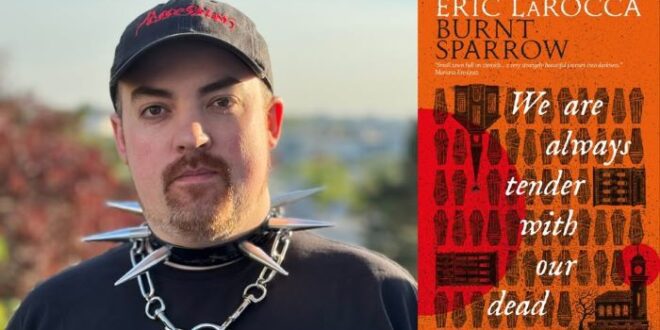
Bram Stoker Award and Shirley Jackson Award nominated, and Splatterpunk Award-winning author Eric LaRocca (The Trees Grew Because I Bled There) is a master at writing vile, violent, visceral horror and that’s what initially drew me to his work. What made me crave more of his stories was the queer characters and his refusal to water down his words to make them more palatable for the masses. Eric’s new book, Burnt Sparrow – We Are Always Tender with Our Dead, comes with a long disclaimer and a promise of “the book you are about to read is profoundly distasteful” (his words, not mine) and the declaration that he had failed miserably at writing “with the utmost delicateness and sensitivity.” Good, Eric, that’s what I want to hear!
The lives of those residing in the isolated town of Burnt Sparrow, New Hampshire, are forever altered after three faceless entities arrive on Christmas morning to perform a brutal act of violence—a senseless tragedy that can never be undone. While the townspeople grieve their losses and grapple with the aftermath of the attack, a young teenage boy named Rupert Cromwell is forced to confront the painful realities of his family situation. Once relationships become intertwined and more carnage ensues as a result of the massacre, the town residents quickly learn that true retribution is futile, cruelty is earned, and certain thresholds must never be crossed no matter what.
Engrossing, atmospheric, and unsettling, this is a devastating story of a small New England community rocked by an unforgivable act of violence. Writing with visceral intensity and profound eloquence, LaRocca journeys deep into the dark heart of Burnt Sparrow, leaving you chilled to the bone and wanting more.
To celebrate publication day, I chatted with Eric about the inspiration behind the story, what’s planned for the upcoming books, queer representation in horror, horror movies, and more!

PopHorror: I really enjoyed the first book in the Burnt Sparrow trilogy, We Are Always Tender with Our Dead, so I’m excited to learn more about it. What sparked the idea for the story?
Eric LaRocca: After the COVID-19 lockdown in the US in 2020, I found myself struggling to re-enter society and perform certain activities/tasks I had enjoyed greatly before being forced to isolate from others. Moreover, I found myself struggling to exist comfortably in crowded spaces, any sort of public forum. I felt unsettled, always anxious about the potential for violence. In a country where mass shootings and violence are so commonplace, it’s difficult not to feel a sense of impending catastrophe each time you leave your house. I really wanted to write a book that spoke about these anxieties, that distilled so many of my fears and phobias into a piece of art that could exemplify some of the elements that are fundamentally incorrect in the United States. I wrote the first draft not long after the release of Things Have Gotten Worse Since We Last Spoke and Other Misfortunes (Titan, 2022) and my mind was very much preoccupied with the notion of “cancel culture” seeing as that collection was very divisive with readers. I wanted to address some concerns I had about the idea of “cancel culture” in the online world. I wanted to dissect the methods in which the online community typically vilify and dehumanize any person who they perceive has committed an egregious act. In many ways, the faceless perpetrators in this book represent the people who have been lambasted and shunned in online spaces for committing what some might deem as horrible offenses. They are stripped of their dignity and their value. I sincerely wanted to address these concerns and pose certain questions to the reader — “Is this right or wrong?” “Should this be allowed?” I’m afraid there are no easy answers found within this book. Then again, there are no easy answers in real life.
PopHorror: No, there really aren’t any easy answers. At the start of the book, there’s a very detailed warning to readers about what could possibly be triggering inside. Was there anything that you were adamant about keeping in the final draft, no matter what? Was there anything that you were forced to, or maybe just decided to, edit out because it went too far?
Eric LaRocca: Yes, indeed. There’s a particular scene about halfway through the book that my editor found somewhat objectionable and suggested the possibility of removing. Although I completely understood her reservations, I thought the scene was powerful the way it was written, and I knew for certain it would shock sensitive readers. More to the point, I consider myself a student of intense, visceral authors like Jack Ketchum, David J. Schow, and Richard Laymon. Those authors never shied away from graphic depictions of brutality and sex. Instead, they leaned into those descriptions and made readers squirm, forced them to stew in their feelings of unease. I wrote a short response to my editor about the reasons I wanted to keep the scene as written and not move some of the content off the page as was her suggestion. In the end, my very kind editor completely understood my motivations for crafting the scene and trusted me to keep the descriptions as they were originally written. I desperately wanted this novel to reflect the viciousness and nastiness of Splatterpunk fiction written in the 1980s and 1990s. Some of my favorite books like Off Season by Jack Ketchum or The Cellar by Richard Laymon are seminal texts of the subgenre, and they are so unabashedly grotesque in their delivery. I wanted this book to feel like a lost artifact from that era—an impossible relic from a bygone time, something only recently discovered and now published for lovers of the extreme and the transgressive to finally enjoy.
PopHorror: We Are Always Tender with Our Dead is the first book in a planned trilogy. What can readers expect coming up?
Eric LaRocca: I feel like there’s a different vibe/aesthetic for each of the books in the trilogy. Perhaps you could even go so far as to argue that each book falls into its own sub-genre. While the entire trilogy could be classified as “transgressive fiction” or “extreme horror,” I think the first book plays with the “folk horror” sub-genre. The second book leans into the “psychological horror” sub-genre and then the third/final book of the series explores the realm of “cosmic horror.” I’m so excited for these books to be out in the world. I hope readers love them as much as I enjoyed writing them.
PopHorror: I’m seriously impatient and can’t wait to read the next one! How do you feel about queer representation in entertainment, mainly the horror genre, and how important to you is that representation?

Eric LaRocca: I think queer representation in the horror genre is extraordinarily important—I believe there should always be a very broad spectrum of representation in the genre. Many folks argue that it’s a disservice to our community to exemplify queer characters as “messy,” “complex” or “problematic.” I vehemently disagree with this. I believe queer characters should be permitted to be grotesque and disgusting, just as they should be allowed to be cheerful and joyful on the opposite end of the scale. I find readers who argue that certain negative portrayals of queer characters are “problematic” or “poor representation” to be extremely misguided in their assessments. It’s fiction. One character behaving poorly in a work of fiction is not a mouthpiece for an entire community. It’s perfectly permissible for queer characters to be complicated and vile. A character in a book is not capable of setting a cultural movement back 50 years because of “poor representation.” Moreover, an author does not deserve to be maligned and spiritually crucified because they simply wrote a book that made you feel uncomfortable.
PopHorror: Yes! I love this and couldn’t agree more. Horror has become a box office powerhouse over the last few years and with that, I feel like horror books are also gaining in popularity, which I love so much because it gets people reading. What draws you to the horror genre, and why do you feel that some people embrace it more than others?
Eric LaRocca: I believe horror is intensely cathartic. I think it’s an inherently safe space where we can analyze and dissect our anxieties, without actually having to be confronted with a physical threat or any kind of immediate danger. I also am of the mindset that horror forces us to confront the truth of the abject, the grotesque, even the perils of our own mortality. Although this may provide some sort of discomfort for most, there are plenty of horror films and novels where the main character achieves a certain kind of transcendence after vanquishing or surviving the antagonist. While I don’t often write hope-filled horror narratives, I do see the value of them and how they can provide an intense release for those who are struggling or afflicted.
PopHorror: I have one last question for you today. What is your favorite scary movie?
Eric LaRocca: Oh, this is an impossible question! There are too many phenomenal films I’ve seen lately to select just one. So, I’m going to cheat and list a few films I’ve enjoyed recently for anyone who might be interested: The Vourdalak (2023), Nosferatu (2024), Longlegs (2024), The Ugly Stepsister (2025), Bring Her Back (2025).

Thank you so much to Eric for taking the time to chat with us. Burnt Sparrow – We Are Always Tender with Our Dead is now in stores!