 PopHorror Let's Get Scared
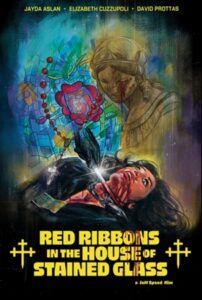
Some horror films try to reinvent the genre. Others proudly embrace everything that made it great in the first place. Red Ribbons in the House of Stained Glass, from writer-director Jeff Speed, falls squarely into the latter category.
Inspired by the stylish Italian giallo thrillers of the 1960s and 1970s, this nearly 12-minute short combines religious corruption, a mysterious assassin, and a desperate journalist willing to risk everything for the story of a lifetime.
And if the title sounds like something you’d find buried in an old Italian horror collection, that’s entirely intentional.
Red Ribbons in the House of Stained Glass – Review
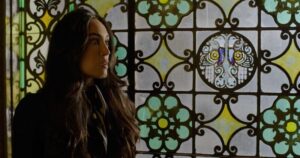
The story follows Iris (Jayda Aslan), a struggling journalist desperate for her big break. When an opportunity arises to expose the sexual crimes of a corrupt Archbishop, she pursues the story despite the growing danger surrounding her investigation.
Unfortunately, someone has other plans.
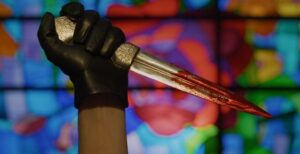
Enter the Lady of the Crimson Cross (Elizabeth Cuzzupoli), a mysterious, deadly figure whose connection to the Church makes her considerably more dangerous than your average masked killer.
What makes Red Ribbons interesting is its commitment to old-school giallo filmmaking. The genre has always emphasized atmosphere, striking imagery, mysterious killers, and elaborate violence, sometimes placing style ahead of conventional storytelling.
Speed embraces those traditions rather than attempting to modernize or parody them.
The film’s setting, a mausoleum filled with stained glass and marble, provides an appropriately Gothic backdrop for a story involving religious corruption and murder. It’s the kind of location that feels perfectly suited to the genre, allowing color, architecture, and religious symbolism to become part of the storytelling.
There’s also something appealing about a filmmaker who knows exactly what kind of movie he wants to make. Red Ribbons isn’t trying to appeal to every horror fan. It’s aimed squarely at those who appreciate the heightened visuals, sinister atmosphere, and theatrical excesses of classic Italian horror.
For longtime giallo enthusiasts, that’s certainly part of the attraction.
Behind the Stained Glass: Interview With Director Jeff Speed
I recently had the opportunity to speak with writer-director Jeff Speed about his influences, the challenges of independent filmmaking, and how a relatively simple idea grew into an ambitious horror short.
Speed’s fascination with horror began at just seven years old, when he watched A Nightmare on Elm Street 2: Freddy’s Revenge. The experience gave him nightmares, but eventually sparked a lifelong love of the genre. His filmmaking journey began with skateboard and snowboard videos before he discovered he could actually pursue filmmaking as a college major.
The inspiration for Red Ribbons started with a simple image: a mysterious woman preparing for a night out, putting on leather boots and gloves before selecting a mask and weapon. When producing partner Philip Barnes introduced Speed to a spectacular mausoleum, the project quickly expanded.
The location ultimately helped shape the entire story.
Speed explained that his goal was to create a genuine giallo film, not a parody or a modern thriller borrowing a few familiar elements. Among his biggest influences were Blood and Black Lace and The Bird with the Crystal Plumage, along with the visual storytelling techniques of Alfred Hitchcock and Tony Scott.
He wanted the images, atmosphere, and action to tell the story rather than relying heavily on dialogue.
We also discussed the film’s performances, particularly Jayda Aslan’s portrayal of Iris. Speed described the character as a woman whose desperation and ambition have pushed her to the breaking point. He praised Aslan’s ability to communicate those emotions with subtle expressions, even recalling an unscripted tear during an especially demanding scene.
Elizabeth Cuzzupoli’s Lady of the Crimson Cross presented a different challenge. Originally conceived as a hired killer, the character eventually evolved into a Vatican assassin. Speed drew inspiration from characters including Destro, Karl Ruprecht Kroenen, and Tim Burton’s Catwoman.
Cuzzupoli’s background as a dancer helped bring the silent character to life through movement and physical presence.
Despite the film’s elaborate visual style, Speed explained that much of the production was carefully planned through repeated location scouts, storyboards, and shot lists.
The biggest challenge actually came afterward.
Working with limited resources, Speed handled much of the post-production himself, learning color correction, sound design, and visual effects along the way. It was a difficult process, but one that allowed him to spend the time necessary to achieve his vision.
As for what’s next, Speed hopes to expand Red Ribbons in the House of Stained Glass into a feature-length screenplay. He’s already completed a treatment and believes there’s considerably more to explore within the film’s world.
Final Thoughts
Red Ribbons in the House of Stained Glass is an enthusiastic tribute to a particularly distinctive corner of horror history. With its masked assassin, religious conspiracy, and emphasis on visual storytelling, it embraces the genre’s traditions without apologizing for them.
It may not be the kind of horror that appeals to audiences looking for straightforward scares or conventional storytelling. But for fans who appreciate stylish thrillers, mysterious killers, and the gloriously excessive world of Italian giallo, it’s worth keeping on the radar.
The film is scheduled to screen at Mountains of Madness in Sparks, Nevada, on November 15, followed by the New York City Horror Film Festival on December 6, 2026.
After its festival run, Speed hopes to make the film available through a curated YouTube horror channel or an ad-supported streaming platform.
For updates, follow Jeff Speed on Instagram at @jeff_speed.
As Speed himself puts it: “Giallo Lives!”