 PopHorror Let's Get Scared

Last year, director Eli Craig released his film, Clown in a Cornfield, a new teen slasher about a murderous clown in a small town. What some people may not know is that Clown in a Cornfield is the brainchild of author Adam Cesare who wrote the first book in the series back in 2020 (yes, there is a movie sequel coming!) while teaching high school English. Adam followed up this bestseller by adding more to the book series, Clown in a Cornfield 2: Frendo Lives, Clown in a Cornfield 3: The Church of Frendo, and the newly released (it came out yesterday) Clown in a Cornfield 4: Lights! Camera! Frendo!
To celebrate the release of book four, I chatted with Adam about violence in YA literature, seeing Frendo at Spirit Halloween, horror movies, and more!
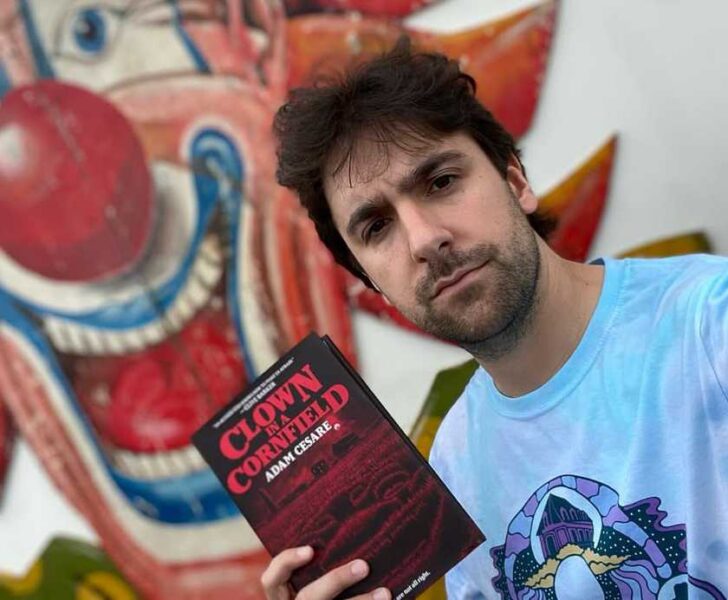
PopHorror: I saw that they just announced the Clown in a Cornfield 2 film!
Adam Cesare: Yes!
PopHorror: Congratulations!
Adam Cesare: Thank you! It’s something I’ve known about for a good long time and it’s funny when people ask me because I have no poker face. People will ask me and I’ll be in TikTok live or I’ll be at an event, and I’ll be like, well, the movie made money. Movies that make money, people want to make more money. I wasn’t saying we’re in talks or it’s in production, I just wanted people to be like, “It’s probably going to happen.” It’s nice being able to talk about it.
Pophorror: Absolutely! I love teen slashers. One of my favorite genres is 90s teen slashers. I was lucky enough to go see the first movie at the drive-in, they had a special engagement and we got a poster and got to see it early. The drive-in… I love it but it also sucks at the same time because if the movie is dark, you miss a lot.
Adam Cesare: It’s not a great way to see a movie.
PopHorror: It really isn’t.
Adam Cesare: It’s a great experience. I love the drive-in very much. I wouldn’t want to see a film for the first time at a drive-in, though. There is a reason they kind of went away.
PopHorror: You’ve built a reputation for not sanitizing horror or gore just because your books carry a Young Adult label. Where do you draw the line? Is there a specific kill or scene that you wrote for the Clown in a Cornfield series that you felt pushed the boundaries of the Young Adult label a little too far?
Adam Cesare: It’s a weird thing because I started out on a small press writing adult horror novels – Video Night, The Summer Job, Zero Lives Remaining. Video Night, chief among them, probably my most popular book before Clown in a Cornfield, was an adult book but it had teen protagonists so it had that teenager voice to it. The whole beginning of my career I was a high school English teacher so it was interfacing with 11th and 12th graders all day every day, which is something that informs my work in a sense that I know what teenagers not only like but can, for the most part, emotionally handle and it’s all the same stuff that adults can handle, at a certain point. The Clown in a Cornfield books actually don’t but I think they’re generally warning labeled enough that there’s going to be a lot of violence in them, but once I add in other things there’s really no topic that I won’t touch in a book. You’re sitting down and you’re writing a book intentionally for a teen audience so you do have to be… There’s a certain amount of good taste and having your head about you, and that is implicit in that but there’s a certain level of just being conscious of that but it’s also like I’m a person with very bad taste who has to remember to have a little bit of good taste. Books like Influencer and Blood Sick that touch on elements that are not so much violence, that are elements that could possibly be troubling, elements of abuse or other things that I feel like it’s fair warning to give readers, those books do have content warnings. The Clown in a Cornfield books don’t in a way that I want to provide readers with full blooded slashers in the sense of like, oh, you’re going to feel… There’s going to be certain kills where you’re going to feel really bad when this character dies and I want it to be and feel visceral and at times upsetting, and then at times not. Sometimes it’s like there’s splatstick in these books almost bordering on Sam Raimi level of violence. The level of violence is never a concern and what I was surprised about is it’s less of a concern for me because I got into these set pieces, these kills and stuff like that, with a certain amount of glee of like, oh, I’ve written all the quote/unquote boring parts of the book- all the dialogue and interpersonal relationships – and now it’s time to cut loose quite literally. I think there are certain sequences in the books that are way harder to take than others. There’s a kill in Clown in a Cornfield 3 that involves a copier machine. It basically involves everything in the copy shop, but I think that’s a really bad one. I think that’s a really violent one and the thing that surprises me about that is not my own capacity to write violence and have it be for a teen audience because I think that the readers of these books, especially by the third book, can hang. The thing that surprised me about that one is that I never hear boo to a goose from the editors and stuff like that. I think what’s surprised me the most about writing YA is not like what are the fetters because like I said, the fetters are all internal. I’ve spent a good part of my professional career talking with teenagers and dealing with teenagers and I kind of have a handle on that, of what they like to see and can handle in books, and I would never write anything that I think is over the line because I don’t think that’s fair, it’s not what the goal of these books is. The goal of these books is to get teens into horror, into the genre. The surprising thing to me about that is that I’ve never really gotten any pushback editorially. I’m just very lucky I guess. It’s not like to say I don’t get editorial input; I get a ton, but it’s never about that. It’s never like the copier machine or the cow kill in four. I should say, someone’s not killing a cow, they’re killed by a cow. It’s okay for animal lovers. That’s been the surprising aspect of this, which leads to a lot of interesting interactions where I’ll be signing at conventions and doing stuff with adult readers who are very much insistent that these aren’t YA books and they kind of mean it as a compliment and I suspect they mean it as a compliment, but I don’t take it so much as one, where it’s like, “Oh, these books are not YA! They’re so violent.” Like these books can’t be YA; I, as a 40 year old, love them.
PopHorror: I do too!
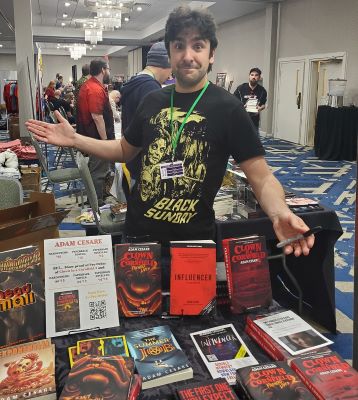
Adam Cesare: I want you to be able to love them. I want adult readers to be able to love them and be able to enjoy them, but I don’t think that discounts the other thing. I think they very much are teen books and they’re very much intended for a teen audience. It came up again when the movie ended up being rated R and a lot of people who hadn’t read the books and had kind of discounted them as kid stuff were like, “Oh, they made an R-rated movie out of this?” Not to be the metalhead gatekeeper guy of like, “It’s way more brutal in the book!”
PopHorror: It is, though!
Adam Cesare: That R-rated movie is significantly toned down in terms of violence and body count than the book, which is fine and is something that I like and something that I feel like I get to share with both my teen and my adult readers.
PopHorror: You start Clown in a Cornfield 4: Lights! Camera! Frendo! with a very brutal kill. I don’t think that it’s really up to you to tone down and police what’s in the book because it’s ultimately up to the reader if they want to read that or if they want to continue reading. You’re not standing there with a gun to their head telling them they must read your book. If they decide that they don’t like it, why would they keep reading it? And that’s really up to them.
Adam Cesare: Oh, yeah. I think all books shouldn’t be for everyone and I think there should be, even within the children’s literature space, which is such a funny thing to say but all my editors at Harper because I’m technically in the Harper Children’s division… But I 100% agree with you and I really do think it’s more honest and it’s more like look, these books are not for everyone. It’s almost good to get it out of the way in the first chapter like, look, this is what it’s going to be and if you’re not cool with this that’s totally cool. I’m not doing this to push anyone away, I’m doing this to extend a hand out to the readers who are going to like this and get something out of it. It’s funny. I’ll talk to authors who read their own reviews and stuff like that and they get really fixated on these one stars and stuff. We were just talking a little bit before the interview started, we were talking about favorite books. Look at the reviews for The Only Good Indians, CJ Leede’s Maeve Fly, those one stars and two stars are plentiful but they’re for people… You and I would just… You might as well be speaking French, we are culturally in a different space than the people that would not like these books, which is completely fine. Any writer who’s worried about that or worried about the audience in that level or that way, really should just think of their favorite book and go to Goodreads and look at the one star reviews. Not every book is for everyone. Write the book you want to read and it’ll all follow.
PopHorror: Absolutely. The Clown in a Cornfield franchise has grown into this massive slasher saga and it even has its own official Spirit Halloween merchandise. Did you ever envision Frendo becoming a commercial horror icon when you were writing the first book as a high school teacher?
Adam Cesare: No, no. It’s funny because no, you can’t ever plan on something like this. I never would have imagined there would be merch, I never would have imagined there would be stuff, but as I say that, I’m such a fan of slashers and we had talked about the 90s slasher boom. I’m more of a 70s and 80s guy. Quite honestly, I’m more of a 70s guy. You see I’ve got my Alice Sweet Alice poster up there, I like all the proto-slashers and like the Bob Clarks and stuff like that but even in Alice Sweet Alice, even in like 76, the idea of iconography of a mask hiding the face is very necessary in certain kinds of slasher storytelling like the whodunit slasher. The mask is so important. I remember writing the first Clown in a Cornfield and handing in drafts to my editor at Harper and him just kind of being like, what’s the fixation? I barely do any physical description of my characters. I kind of want readers to be able to pour in their own casting of characters. I’ve always been that way with writing and I feel like it’s very non-YA. I’ll read a lot of YA for blurbs and stuff and it’s down to the jeans they’re wearing. Why is this such a thing? But I understand it’s a little bit of a thing for teenagers, “I need to get a picture in my mind!” and I just run the opposite where I do a very spare description of a lot of these characters. But when it comes to Frendo and what he looks like and what the costume looked like, I was super exacting so I remember my editor pointing that out and it kind of feeds into the question. This stuff has to be very planned and very concrete because of what he looks like. It needs to be an icon; you have to believe he’s an icon within this town, even before Frendo becomes a slasher. It’s all about branding, it’s all about Americana and it’s all about all of these things so it has to look a certain way. Even for the first book, Matt Ryan Tobin, the cover artist, didn’t even draw Frendo. He drew the impression of Frendo on grass. It was very important to me as a slasher fan, even in my own head canon and imagination, he has to feel a piece with your Jasons, your Freddys. He has to have a look and I’ve been very conscious too within the sequels there are a lot of variations on Frendo, which is very consciously like a Halloween II thing, the blood on the eyes. There’s this idea of evolving masks and evolving the look of a slasher and having variances of slashers. Again, pre-movie, there’s no intention there of being pitches for movies. No, there are great literary slashers. The slasher is a cinematic format, it is a cinematic tradition, it’s not a literary one so I really wanted to embrace that part of these films that I love. It just happens that I spent six or seven years imagining these things would be real and then it’s crazy to go into Spirit Halloween and be like, there he is!
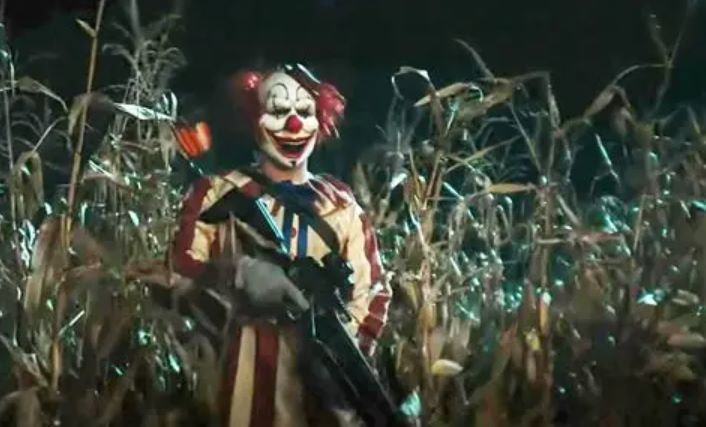
PopHorro: That’s so awesome! You mentioned the variations of Frendo as the books go on, and they talk about the masks like this one might be an older one and the material it’s made out of and how aged it is. And this person made their own.
Adam Cesare: There’s fan Frendo masks, especially in two there’s a lot of Frendo imposters, which I found fun. It’s that idea of if this were real, how people go about doing it. Not to spoil too much but in book four, movie Frendo – Eli Crag’s version of Frendo, Doug Morrow designed the mask – is very different from how, or at least to me is very different, he’s described in the books because it’s a latex pullover mask and in the books it is a pressed plastic half-mask that only covers your face. In book four, it seemed too good not to just have movie Frendo versus book Frendo, which almost the whole book is built around this idea of let’s have fun with this – the tension, the differences between the film and the book. I didn’t want to do it in a way that felt like I was snarking on anyone. That’s why the other details of the movie within the book are very different from the real life Clown in a Cornfield movie and I think that really helps separate… Adam’s not making fun of Eli Craig, Adam’s not making fun of the film because I very clearly love the film and I’m a big supporter of the film, but I did want to have a little fun with movie Frendo versus book Frendo.
PopHorror: Of course. It’s your creation, you can do whatever you want with it. If you had to survive in one of your books, which one would you have the best odds?
Adam Cesare: I have a book called Influencer that is about a sociopathic Instagram poet basically seducing a group of high school friends like getting them to do his bidding Manson Family-esque and I think because I am such an agoraphobe and I was such a loner in high school that I probably wouldn’t get sucked into having friends that I’d be safe in that one.
PopHorror: How funny. I have not read that one but I will add it to my list. I have just one last question for you today. What is your favorite scary movie?
Adam Cesare: It changes every time. It’s the same where the Joker gives a different origin story every time. I just love movies so much and I love horror movies so much. We could look behind me. For the reader, I have a lot of posters on my wall. We’ll go with Frank Henenlotter’s Basket Case. I think that’s the kind of horror that I like the most. I’ve got Daughters of Darkness there, I love vampire stuff, that’s why I’ve got a vampire book coming out. A good one that I go to a lot is Dawn of the Dead, the original. Audition, Miike’s… Those are generally in the conversation of my favorite horror movie. My favorite director’s probably David Cronenberg. We’re going all over the map! I think those are pretty varied in their tones and approaches to horror so it’s impossible for me to pick one because there’s a bunch that I love. That’s what I love about the genre; it’s a really big umbrella with a lot of different flavors to it so that’s why I do what I do.
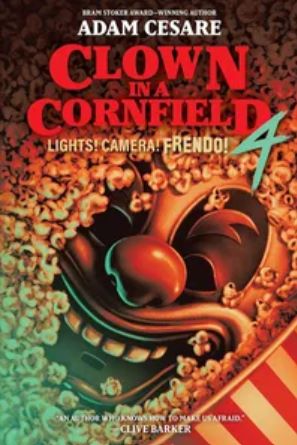
Thank you so much to Adam for taking the time to chat with us. All four of the Clown in a Cornfield books are available wherever you buy books now!